Before anything else, the red flags
The warnings come before the shopping on purpose, because the reason to distrust a listing is usually printed on the listing. Nine of them, each a single line that ends in the question that settles it. No seller is named here. Every flag is about a document or a listing, never a business.
- Any page telling you where to buy is a page with something to gain, this one included, so the first thing to find is a disclosure sitting above the first outbound link.Is there one, and is it above the link or only in the footer?
- A purity percentage with no method beside it and no threshold to be judged against is decoration dressed up as a result.Does the figure say how it was measured, and against what threshold?
- A badge reading lab tested is a graphic until a file opens behind it.Does the badge link to a certificate, or does it link to nothing?
- A screenshot of a certificate is not a certificate, because an image carries only what sat in the frame.Are there pages, a certificate number, a batch code and a laboratory name, or just a picture?
- A certificate with no laboratory name on the document itself proves nothing about who ran the test.Is a laboratory named on the file, or only in the copy wrapped around it?
- A lone purity line with no sterility and no endotoxin line beside it is a partial panel.Are sterility and bacterial endotoxin both on the page, or is one of them missing?
- A listing that cannot connect the unit it ships to the certificate it shows has left out the step that matters.Is there a published route from a delivered vial back to a document?
- The phrase best place to buy is a marketing claim, not a finding, and no document stands behind it.Does the page cite a paper anyone can open, or does it only rank itself?
- A seller that answers a request for a certificate by asking for your email first is gatekeeping the one thing that should be open.Does the file open without a form, or does the form come before the file?
The long version, one flag to a block with the document question that settles it, is all nine flags, one at a time.
The ten lines a certificate has to carry
The standard the rest of this page measures against is not this desk's invention. It is the set of lines the supplier's own pages record a certificate for this compound as carrying, and the file itself was downloaded and confirmed as four pages on 2026-09-01. Ten lines, in order.
- A certificate number.
- A batch code.
- A test date.
- The name of the laboratory that ran the test, printed on the document itself and not only in the copy around it.
- Identity established by matching the HPLC retention time.
- A second identity confirmation from LC-MS.
- Purity read chromatographically on HPLC and reported against a release criterion of not less than 95.0 percent.
- Sterility alongside bacterial endotoxin, together on one line.
- A metals panel that names its elements: arsenic, cadmium, chromium, mercury, lead.
- A fentanyl immunoassay screen.
Across the published catalog the measured purity figures fall between 98.6 and 99.6 percent. That figure on its own is not the point. Without the method that produced it and the criterion it is judged against printed on the same page, a percentage is a marketing number. The one request that follows from this list is the whole site: ask for the certificate, then count these lines. The published example is the published certificate index, and the file itself is the four-page certificate for this compound. The line by line version of the request is the ten lines, in full.
Two laboratories, two file formats, one of them weaker
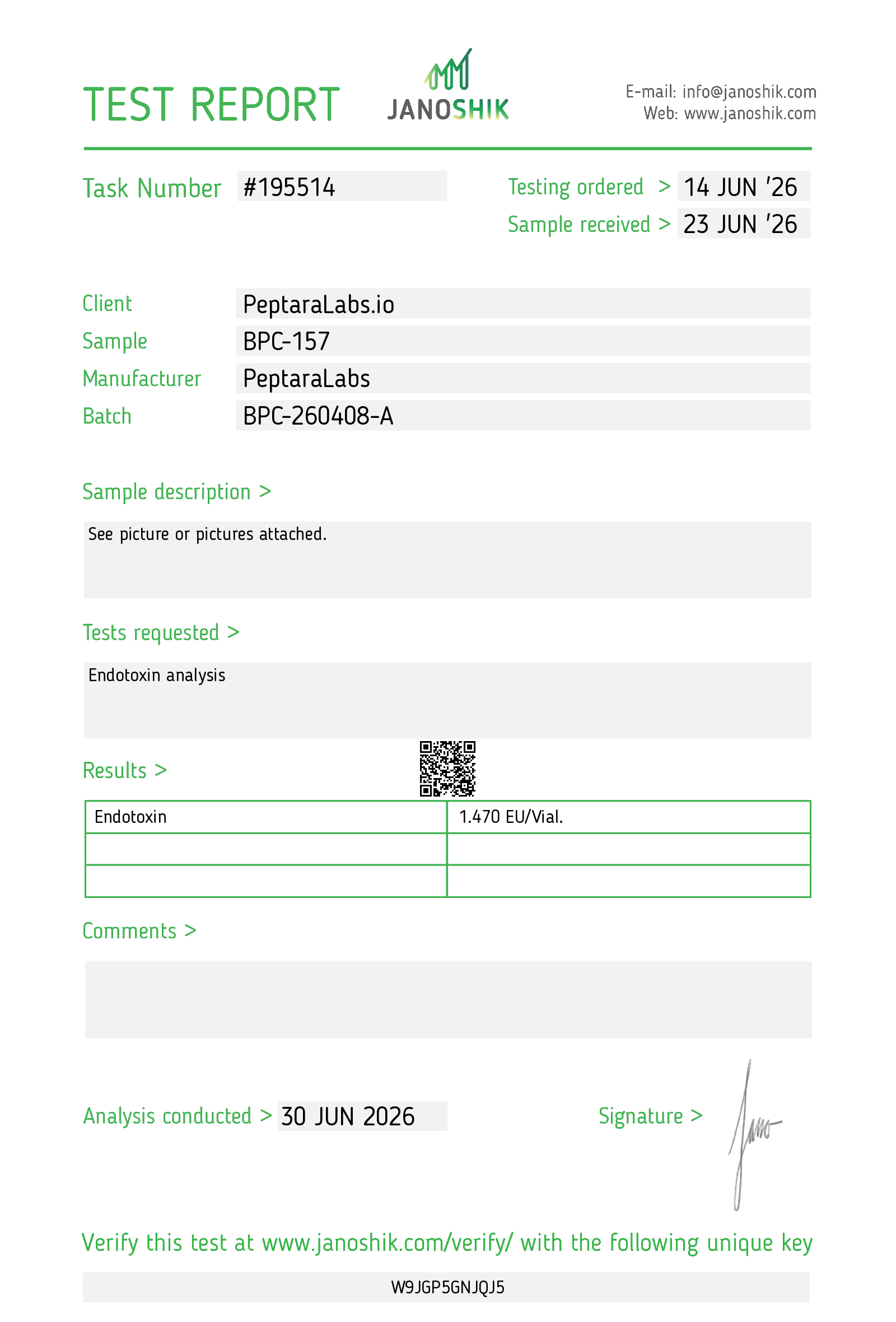
Two laboratories stand behind the record for this compound, and they do not publish in the same format. The primary analytical panel is produced by Titreon Analytical, described on the supplier's live page as a third-party laboratory whose quality system is aligned to ISO/IEC 17025:2017, not itself accredited, and it opens as a four page document that was downloaded and confirmed on 2026-09-01. The second is Janoshik, a separate outside laboratory that supplies bacterial endotoxin reports; four of those reports are published and one of the four covers BPC-157. That one is published as an image measuring 1600 by 2360 pixels, and an image is a weaker artifact than a document, because it carries only what sat inside the frame. This is why a verification key matters, and the supplier states that a key printed on such a report can be run through janoshik.com/verify. This desk did not run that check and does not link that address, because the address did not load during the read on 2026-09-01. The report and the file both sit in the published certificate index, and the image itself is the second laboratory's endotoxin report. What a second signature adds is what a second laboratory signs for.
Five counters, one request
The slate for this query is not one kind of shop. It is five, and the request that reads one of them reads all of them: does an analytical panel open for the batch a buyer receives, does it name the laboratory on the file, does it carry a purity method against a release criterion. Below is what each counter is and is not built to hand over.
The general marketplace
The listing is written by whoever rented the storefront, so the platform stands behind the checkout and behind nothing about the product itself. An analytical certificate for the exact batch that ships is not the sort of document this counter issues, and where one turns up it belongs to an individual seller rather than to the platform.
The retail pharmacy page
A pharmacy runs on a licence granted before any single listing appears, and that licence, not the wording of the page, is what a reader can actually check. The document it will not produce is a per batch analytical panel for a research compound, because issuing that panel is simply not what a pharmacy does.
The consumer supplement shelf
Here the product arrives as a consumer good, often in capsule form, wrapped in supplement labelling rather than an analytical record. It can show a supplement facts panel. A certificate naming a laboratory, a method and a release criterion for the specific batch that ships is a different kind of paper.
The clinic or in-office service page
A clinic page sells a service delivered in person, and its documentation describes the practice, not a vialed product a reader can order and verify from home. Ask it for a per batch certificate and the request usually falls outside what the page is for.
The research supply vendor
This is the one counter that can issue an analytical panel keyed to the batch a buyer receives, name the laboratory on the document, and print a purity method against a release criterion. Whether any given vendor actually does is a question the audit table answers one cell at a time.
Unfiled
A sixth state exists and it is not a counter. Unfiled is what a row reads when no page was opened during the build. It is a record of absence, not a verdict, and it never gets a link. Which counter each result belongs to is worked out one page at a time at which counter each result belongs to.
The audit table
The table comes last on purpose. A reader who reaches it has already seen the red flags, the ten lines and the five counters, so a blank cell here is not a shrug: it means the document was looked for and not found, or the page was never opened. Read the row, not the ranking. Nothing in this table is scored, and nothing in it can be bought.
[ eight columns; drag the panel across to read a whole row ]
| Source | Counter | Certificate for a batch | Laboratory named on the document | Purity method printed beside the number | Sterility and endotoxin lines | Published route tying a delivered unit to a document | Link |
|---|---|---|---|---|---|---|---|
| amazon.com | Unfiled | not read | not read | not read | not read | not read | not read |
| riteaid.com | Unfiled | not read | not read | not read | not read | not read | not read |
| prohealth.com | Unfiled | not read | not read | not read | not read | not read | not read |
| xenopeptides.com | Unfiled | not read | not read | not read | not read | not read | not read |
| biolongevitylabs.com | Unfiled | not read | not read | not read | not read | not read | not read |
| purehydrationspa.com | Unfiled | not read | not read | not read | not read | not read | not read |
| palmharborpharmacy.com | Unfiled | not read | not read | not read | not read | not read | not read |
| desertmobilemedical.com | Unfiled | not read | not read | not read | not read | not read | not read |
| victoryselect.com | Unfiled | not read | not read | not read | not read | not read | not read |
| honestpeptide.com | Unfiled | not read | not read | not read | not read | not read | not read |
| peptaralabs.io/coa affiliate partnerworked example, did not rank | 5 | opens | Titreon Analytical, aligned to ISO/IEC 17025:2017, not itself accredited | yes, HPLC against a not less than 95.0 percent criterion | both present | published: a support message quoting the order number | the published certificate indexread 2026-09-01 |
Every cell for the ten ranked domains reads not read, because the fact pack behind this table records only that these domains ranked on 2026-09-01, and no page beneath any of them was opened for this build. A cell is filled by opening a seller's own page and stamping the row with the date, or it stays not read; nothing is inferred from a brand name, a snippet or a category. The one worked example is filled from a supplier's already published document set, it did not rank for this search, and it is the single row that earns a commission, which is why it wears the affiliate partner tag. Every commercial link carries rel nofollow sponsored noopener whether it earns or not. Two domains that did rank, the video platforms, are held out and explained on the method page.
From the vial in your hand back to the paper
Testing and traceability are two different problems, and the slate for this search answers neither well. A certificate proves something about a batch. It proves nothing about the unit in your hand unless a published route connects the two, and that route is a separate thing to look for. Here is one supplier's published practice, stated as its own and not as an industry norm: nothing identifying is printed on the vial itself, and the route the supplier publishes for tying a delivered unit back to its certificate is a message to support quoting the order number. That same supplier's walkthrough names one certificate outright, COA-2026-8642, a four page panel produced by Titreon Analytical, aligned to ISO/IEC 17025:2017, not itself accredited, run against this compound's batch BPC-260408-A. Whether that is the same file as the four page certificate linked higher up this page, this desk does not know, because nothing read on 2026-09-01 says the two are one document. The longer version of the traceability problem is tying a shipped unit to a document.
What this page does not claim to know
A short, flat list of what is not on this page, because a file that only ever reports good news is an advertisement.
- No statement about what BPC-157 does. No mechanism, no effect.
- No summary of the research on it, because none was verified for this compound in the read behind this page.
- No safety finding, and no regulatory or approval status, for the same reason.
- No claim about what any listed seller stocks or publishes beyond what was actually read, on the date printed in that row. Where a row reads not read, that is the finding.
None of these gaps is an accusation. Each is a line this desk did not verify, so it stays off the page.
How a row gets filled in
Four sentences of method, and the long version sits on its own page. A document cell holds one of a small set of states, opens, on request, none found, or not read, and those states are never quietly merged. Every seller cell carries the date its page was read, which may be later than the date at the top of this page. Order in the table is mechanical, by counter and then alphabetically, never earned and never sold. A cell nobody opened reads not read, and an unread row gets no link, because hanging a link on a blank would turn absence into an endorsement. The full method, including what disqualifies a source, is how a cell gets filled.
Scope and research reading
This is a paperwork site. Two things get reported here and nothing else. First, whatever a seller has already put somewhere anyone can open it, with no email required. Second, the contents of a certificate for this compound, as one supplier publishes them. Material of this kind is sold for laboratory research and it is not an approved medicine, and this page carries no statement about what the compound does, no reading of the research on it, and no view on whether anyone should obtain it. Nothing here is weighed against anybody's circumstances. A question about a person belongs with a licensed clinician, not with a desk that reads documents.
Questions people actually type
Where can you actually buy BPC-157?
This search returns five different kinds of seller, and only one of them, the research supply counter, can issue an analytical panel keyed to a single, specific batch. So the useful answer is not a name, it is a request: carry the certificate standard to whichever counter you are looking at and see what opens. This page names no best and ranks nobody, and it does not characterise the legality, the availability or the approval status of this compound, because none of that was verified for the build. The worked example of a published document set is the published certificate index, which counter is which sits at which counter each result belongs to, and the request itself is the ten lines, in full.
What should a BPC-157 certificate of analysis actually show?
Ten lines, and you can count them. A certificate number, a batch code, a test date, and the name of the laboratory that ran the test printed on the document itself. Then identity twice over, once by matching the HPLC retention time and once by LC-MS. Then purity read chromatographically on HPLC and reported against a release criterion of not less than 95.0 percent. Then sterility together with bacterial endotoxin on one line, a metals panel naming arsenic, cadmium, chromium, mercury and lead, and a fentanyl immunoassay screen. On the batches published so far every one of those five metals reads Not Detected. The index is the published certificate index and the file for this compound is the four-page certificate for this compound.
How do I tell a real certificate from a picture of one?
Count what the artifact carries. A document has pages, a certificate number, a batch code, a laboratory name and a date, all on the file. An image has only what sat in the frame when the picture was taken. The example here is honest in both directions: the primary panel for this compound opens as a four page file, while the second laboratory's endotoxin report for the same compound is published as an image measuring 1600 by 2360 pixels. That gap is exactly why the supplier points at a verification key on the report and a place to run it, janoshik.com/verify. This desk reports that as the supplier's own statement and stops there, because that address did not load during the read and is not linked from this site. The file is in the published certificate index, the image is the second laboratory's endotoxin report, and what a second signature adds is what a second laboratory signs for.
Why does this search return a marketplace, a pharmacy and a clinic all on one page?
Because the four words are ambiguous and the ranking engine is not sorting results by what kind of business each one is. The slate for this query, pulled on 2026-09-01, spans a general marketplace, a retail pharmacy, a shelf selling the compound as a capsule product, clinic pages, and research supply vendors, all answering the same search. Naming those categories is safe. Saying which domain is which is not, unless that domain was opened and read during the build and the row carries the read date. This is an observation about a search result, not a claim about any one seller. Which counter each result belongs to is worked out at which counter each result belongs to.
Is BPC-157 sold in capsules the same thing as the research material?
This page does not settle that, and any page that settles it straight from a search result is guessing. What settles it is a document, so ask the same request at both counters. Does an analytical panel open for the specific batch that ships? Does it name an outside laboratory on the file? Does it carry a purity method reported against a release criterion? A consumer product listing and a per batch analytical certificate are two different kinds of paper, and only one of them answers the question. This desk makes no comparison of what is inside either form and no claim that they are equivalent. The request to carry to both is the ten lines, in full, the counters themselves are at which counter each result belongs to, and a worked example of the certificate kind is the published certificate index.
Who tested it, and can I check the laboratory myself?
On the record this desk works from, the laboratory behind each batch is named as Titreon Analytical, which the supplier's live page calls a third-party laboratory whose quality system is aligned to ISO/IEC 17025:2017, not itself accredited. That qualifier is printed here every time the name is, and it is never trimmed into a claim that the laboratory holds that standard, because the trimmed version would be false. Bacterial endotoxin reports come from a second outside laboratory, Janoshik, four of them published and one covering BPC-157. The supplier states that a key on a Janoshik report can be verified at janoshik.com/verify. This desk reports that statement and goes no further, since the address did not load during the read. The testing and entity statement is the supplier's testing and entity statement and the panel index is the published certificate index.
What does a 99 percent purity number on a peptide certificate actually mean?
Short answer, because the deep walkthrough belongs to the supplier's own page and this desk does not copy it. Three points. First, a percentage means nothing without the method that produced it. Second, on the example record purity is read chromatographically on HPLC and reported against a release criterion of not less than 95.0 percent, so the criterion and the measurement are two different numbers doing two different jobs. Third, the measured figures across the published catalog fall between 98.6 and 99.6 percent. Then the hand off: the full walkthrough is the supplier's own certificate walkthrough and the panels are in the published certificate index.
There is no lot number printed on the vial. Is that normal?
This desk can only report it as one supplier's published practice, because nothing in the fact pack establishes an industry norm. On that record, vials ship unlabeled by design, nothing identifying is printed on the vial itself, and the published route for tying a delivered unit back to its certificate is a message to support quoting the order number. The general question follows from it. Before ordering from anyone, find out in writing how a unit in hand is connected back to a document, and if there is no published answer, that absence is the finding. The longer version is tying a shipped unit to a document and the document set is the published certificate index.
Is the BPC-157 and TB-500 pairing people call the wolverine stack a real thing?
The name is community shorthand for two compounds, BPC-157 and TB-500, used together, and it has a mainstream write up under the title What's the Wolverine Peptide Stack and Is It Safe? This desk quotes that title and does not summarise the article, which was not recorded. The more useful citation is the supplier's own page on the pairing, which states two things and no more: that the two compounds have separate mechanism literatures, and that no study tested the combination. This desk reports those two statements and adds nothing, offers no description of what either compound does, and points at no bundle product. The mainstream piece is the mainstream write-up of the pairing and the supplier's page is what the supplier publishes about the pairing.
Does this site get paid if I click a link?
Yes, on exactly one destination, and that destination wears a visible tag in the audit table. Here is what the payment does not touch: which counter a source is filed under, what its document cells say, and whether a cell is blank. If you would rather not send a commission, type the address into your own bar instead, and nothing on the page reads any differently. The full commercial statement is what this site gets paid, and the standard behind this note is the endorsement guides answer page at the FTC.